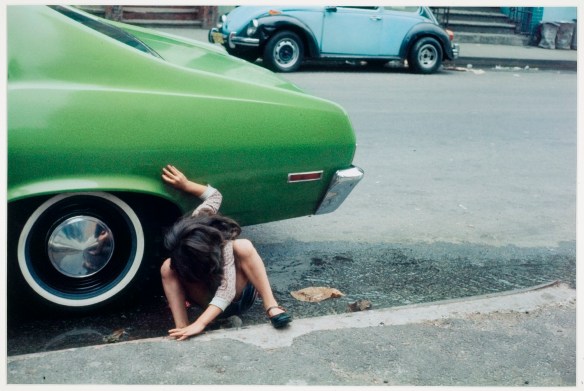
Helen Levitt, [Spider Girl] New York, 1980

Boris Savelev, Café Ion, Moscow, 1987
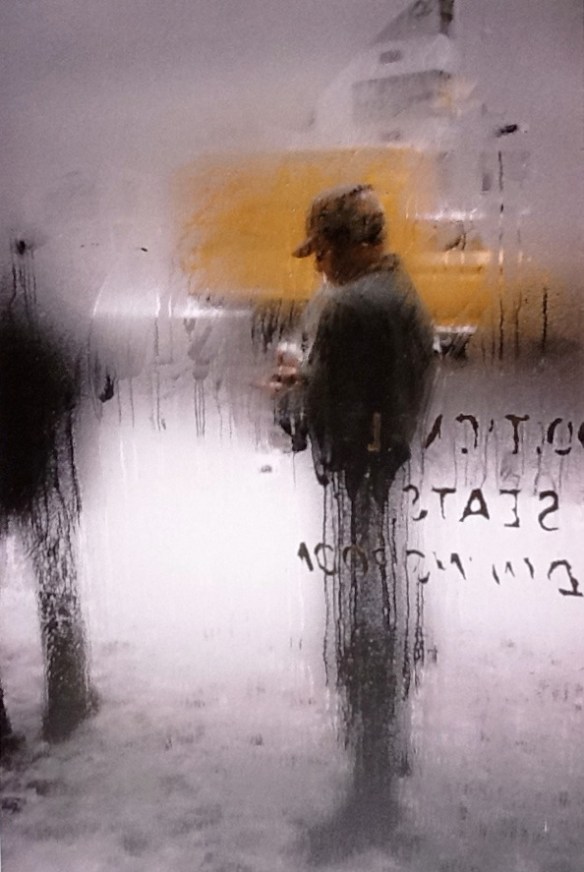
Saul Leiter, Snow, 1960
A very fine new exhibition at Somerset House in London (Cartier-Bresson : A Question of Colour, until 27th January 2013) throws a searching light on a number of interrelated things. Curator William A. Ewing has managed something of a tour de force in assembling a dozen or so practitioners who use colour in different ways. In the exhibition rooms, Ewing has hung the pictures in small groups by author, revelling in the way the variations of approach evoke variations in our response.
In my own review for the Financial Times, I wrote of a sense of synaesthesia, that peculiar deflection of the mind whereby for some people colours are read as smells or as sounds. And indeed, although not markedly synaesthetic myself, I find the experience of Ewing’s rather brilliant hang at Somerset House to be a musical one: each group of pictures sets up a tonality which rings in deliberate harmony or dissonance with its neighbours across the wall or over the angle of a room.
There are chamber players, users generally of more delicate colours: Harry Gruyaert, Boris Savelev, Saul Leiter, Fred Herzog… There are pianists and singers, the users of naturalistic colours: Jeff Mermelstein, Melanie Einzig… There are jazzmen, those who take delight in the brighter, shriller colours of the modern urban environment: Robert Walker, Karl Baden… Ewing never actually says so, but he tends very close to the idea that colour sets a mood in the viewer, which is then either developed and resolved by the other details in the picture, or deliberately contrasted to something, leaving the viewer aware of precisely the point of non-intersection which the photographer wanted to bring to his attention.
This procedure is also a musical one, albeit one mightily compressed. In music, notably in classical music, we are well used to the elaboration, counterposition and resolution of themes. Even those of us who are not trained in music hear the echoes of what we heard towards the beginning of the piece in what is offered to us later. Emotion hangs on to snippets of melody or of harmony in such a way that when we hear the latter stages, we are in effect hearing chords of the actual music playing over the remembered. No difficulty there: it is our shared experience of how music actually works. But still photography appears to lack the element of time, and therefore to be incapable of such a reading.
William Ewing’s show at Somerset House goes some way to showing how it can be so all the same.
Viewing a photograph is always a rapid process. I have argued for a number of years that the prime challenge for every photographer in every picture is to keep the viewer’s eye upon it long enough to get his messages across. The ‘usual’ surface of a photograph is rather repellent to the eye. It is slippery, skiddy. The eye bounces off it. This contrasts with bronze, paint, pastel, charcoal… All of those have microscopic traps and pools of darkness built into their very texture to offer stepping-stones to the eye as it moves over them according to the lines of composition. In music and film, of course, the hearer/viewer is kept there for a longish period automatically, in the very nature of the process.
Further, a photograph at ‘usual’ sizes (shall we say magazine sizes, smaller than an A4 sheet?) is always potentially viewed as one single gobbet of information. The viewer instinctively boils it down to a caption in his mind, which having filed, he feels under no obligation to glance at the picture again.
There is ample physiological evidence that the eye moves over the surface of a picture in jerky tics of focus, and the brain processes a bit from each. But if a photograph is consumed at a bite, it has no chance to yield up anything more than its most superficial flavours. The daily experience of all of us – dozens and dozens of images viewed per day, rapidly and without deliberate thought – confirms how high a proportion of our photographic diet is junk.
Photography, it goes without saying, is capable of great complexity and subtlety – as great, indeed, as any other medium at all. But it’s no good offering subtlety if the viewer isn’t there any more. So the photographer who has anything at all complex or subtle to say has as his very first hurdle to overcome a tricky puzzle of how to keep the viewer’s eye on his work long enough. He has to build resting places for the brain if there are none for the eye.
Some of the methods used are passably crude. Over a number of years, art photographs as exhibited on gallery walls and as offered for sale to collectors have been swelling. This is mainly coarse real estate: ask a hell of a lot of money for a picture, and at least cover a lot of the customer’s wall. Pictures aren’t sold by the square centimeter, but in a lot of contemporary galleries, they might as well be. The gigantism in contemporary photography is often absurd, yet it does chime with good sense at least to this degree: if a picture is huge, it is impossible to pretend to grasp it at one glance. Supposing that it has enough content to reward a viewer, it does make some sense to make it large as a way of keeping him there.
Other methods are not crude at all. Intriguing or puzzling composition will hold a viewer a while. So might a contrast between what viewers already know and the new or unexpected that a photographer can bring them. So might a very delicate printing process, removing and replacing that skiddy surface by something more velvety to the eye.
And so (with my apology for taking so very long to get there) might careful and intellectually coherent use of colour. William Ewing knows about this very well. I’m not much of book collector, but I wish I had bought his wonderful edit of pictures by Ernst Haas (Prodger, Philip, & Ewing, William A., Ernst Haas: Color Correction, Steidl, Gottingen, 2011), already quite absurdly and unaccountably out of print. Haas had the reputation of being a bit crude with his colour, a bit Getty Images. But Ewing went through the archive and proved that it was not so: that Haas used colour as an intellectual tool, and that long before the feted Stephen Shore generation of colorists after Eggleston’s breakthrough show.
As so often happens in photography, though, Haas was a commercial animal and most of his work was in the context of the then-thriving illustrated magazine business, so his inventiveness and skill was not much seen and even less appreciated by those who thought only in terms of photographic art. Not everybody in Ewing’s Somerset House show was or is mainly a commercial photographer, but a strikingly large number are. Cartier-Bresson, after all, in whose shadow the whole exhibition is set, always had some difficulty in thinking of himself as a journalist.
Having said all of that, it begins to make sense to find in Ewing’s show a vision of the way we view pictures as closely parallel to the way we hear music.

Harry Gruyaert, Near Five Point Crossing, Calcutta, 2001
Harry Gruyaert shows us a man with his head in his hands, sitting among the discarded leaves and lengthening shadows of what looks like a vegetable market at closing time. It’s a photograph so, as usual, we have no way of knowing what is in the sitter’s mind. Gruyaert tells us what he thinks it might be, though. That yellow cab is not going fast: the people in its way are not disturbed by it. But its very energy sets a colour for our reading of the photograph. Impossible to see the man as anything other than distressed, once the yellow has been absorbed. Add two other colours in a view which elsewhere is drab: a blue shirt in the foreground, behind railings, and a red cloth on a cart. Those three primary colours triangulate the man: he’s caught in the middle of them. Could there ever be a clearer graphic depiction of a dilemma? Scylla and Charybdis, with the yellow increasing the intensity a lot. It’s not a scream, though. The colours are strong but not bright. Our eye moves back to the man. He might be merely holding a mobile phone to his head and shielding his ears from other noise. Plausible as a reading of the man alone, impossible as a reading of the picture. Those colours have told us not what is real, but what Gruyaert wanted us to know. Suddenly, this perfectly factual street photograph, unmanipulated, has become partially a fiction of the author’s. That’s clever, and it takes a few moments to get it. Only by holding on to one element of the picture as the next takes its effect have we any chance of reading it so. Like music, then, but almost instantaneous at actual speed.

Robert Walker, Times Square, New York, 2011
Robert Walker found a burly man apparently shifting glass. The structure of the picture is much more complex than Gruyaert’s simply by dint of the many layers of reflection. It’s quite hard to see whether we are inside looking out or outside looking in. Hard to see, but a pleasing enough puzzle to keep us there. The eye sets about unravelling the puzzle, and suddenly we’re held. Reading the mysterious reflections leads us to look for certainties. The man’s shoulders are good and butch, clearly legible. Tattoo, vest, all clearly masculine enough. His upper arm, likewise. But suddenly, he’s a centaur, with womanly hips and legs, and a pair of dainty woman’s arms. We could have trouble misreading this, except for three things: Lace Gentlemen’s Club, it clearly says (not clearly in my poor reproduction, I’m afraid). Very quickly, the brain is processing: lace and gentlemen? It’s a perfectly boring strip club, probably, but lace is feminine and gentlemen are not: we have a confirmation in words of what we’d already half seen in graphic form. Another thing: the brightest element in the centre of the picture says ACME. We can’t miss it, even though we don’t quite know what to make of it; except that ACME is easily misread as CAME. It’s not close, but it’s close enough. Brains do misread like lightning. What could it be? Half a sentence, some kind of sexual allusion: we’re in the same territory. The elements of the picture are beginning to pull together. And then finally, to confirm the whole, that wash of pink light overall. Pink, of all colours the one most intimately connected with gender. Pink, which used in the eighteenth century to be a masculine colour (and still is in such things as matador’s socks), but which has now shifted to the feminine. This is not just a picture of a man surrounded by fragile glass, trapped within it and trying to shift it. It’s a picture of a man of uncertain sexuality, trapped in shimmying harmonies of sexual pros and cons. But you’d only get that if you stayed at it for long enough.
I am aware that reading pictures like this in words is tremendously awkward; slow and clunky, almost moronic. It has taken me for each picture a long paragraph to mimic what the eye can do in a flash, half a second at the outside. But I am certain that this is what eye and brain do together when reading pictures. We look for clues. If they pull in different directions, or can’t be resolved, we pass on. Either the picture contains nothing, or we haven’t ‘got’ it. Away, no regrets.
But if we begin to see that strong tides are all flowing together from among composition, fact, light, colour, and tone, then we will go with then as far as they can carry us. It is exactly the way we understand music, only we do it at lightning speed.
There are plenty of other equally interesting elements of William Ewing’s exhibition, but for now, enough. The catalogue is excellent and contains not one but two very fine essays on Cartier-Bresson and his legacy.

 Francis Hodgson