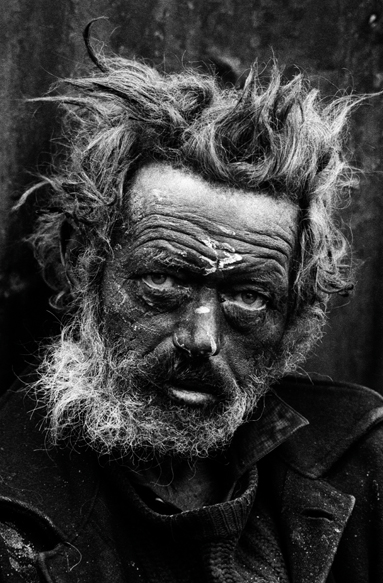
Robert Brownjohn’s Street Level Series

Robert Brownjohn.  From the Street Level series, 1961.Victoria & Albert Museum

Robert Brownjohn. From the Street Level series, 1961.
Victoria & Albert Museum

One of the pleasing things about being interested in photographs is that it is really perfectly OK to admit to not knowing even important groups of pictures. In a narrower specialism, say in craft pottery or in modern literary fiction or in contemporary dance, it’s embarrassing to miss first-rate stuff.  In photography you can even turn the whole argument around:  far from being embarrassing to have missed something, it may be that to live only with those pictures that have good kudos in your particular neck of the photographic woods is to be limited, to lack curiosity and openness.

The new and the new-to-me is a powerful stimulant. It’s by checking one’s reactions against the new that one improves one’s antennae.  It’s the fear of the new which makes so much commercial photography stultifying.  Don’t forget that the word cliché is French for a snapshot. Clichés are merely the standard thoughts of those frightened by the new. I think there’s a lot of fear of the new in specialist areas, too, like sports photography, although there the problems of access and delivery are so great that perhaps there are some excuses.

It is good periodically to meet the new-to-me face to face.

Robert Brownjohn.  From the Street Level series, 1961.Victoria & Albert Museum

Robert Brownjohn. From the Street Level series, 1961.
Victoria & Albert Museum

Robert Brownjohn.  From the Street Level series, 1961.Victoria & Albert Museum

Robert Brownjohn. From the Street Level series, 1961.
Victoria & Albert Museum

Robert Brownjohn.  From the Street Level series, 1961.Victoria & Albert Museum

Robert Brownjohn. From the Street Level series, 1961.
Victoria & Albert Museum

Robert Brownjohn.  From the Street Level series, 1961.Victoria & Albert Museum

Robert Brownjohn. From the Street Level series, 1961.
Victoria & Albert Museum

Robert Brownjohn.  From the Street Level series, 1961.Victoria & Albert Museum

Robert Brownjohn. From the Street Level series, 1961.
Victoria & Albert Museum

In the latest re-hang of the Victoria & Albert Museum’s photography gallery, there is a group of pictures of lettering found in situ on London’s streets.  I admit, I did not know these pictures, and while I certainly knew of their author, I did not think of him as a photographer.  They date from 1961, are by Robert Brownjohn, and, like so very much interesting photography, they were not originally made with any interest in what they might be as photographs.

Brownjohn was a designer, a good one. Born in America as the son of an originally British bus-driver, he had studied with Lászlό Moholy-Nagy at the Institute of Design in Chicago, then with Moholy-Nagy’s successor, the architect Serge Chermayeff, before coming to England in 1960.  He was a member of that New York crowd of the 1950s centred on such luminaries of the cool jazz as Miles Davis and Stan Getz.  Later, he became a key figure in the Swinging Sixties in London.   A pioneer in several fields of design, he was also an addict, who died before he was fifty.

There was an exhibition devoted to Brownjohn’s work at the Design Museum in London in 2005. The Museum of Modern Art in New York is still showing (for a few days – until March 18th 2013) a little study of the famous and influential title sequence he designed for the James Bond film Goldfinger.  The exhibition organizers Juliet Kinchin and Aidan O’Connor tell us [
http://bit.ly/XWVkXg
] it was “the first film title sequence to enter MoMA’s collection as a design work in its own right… As memorable as the film itself, the title sequence of Goldfinger (1964) captures the sexual suggestiveness and wry humor of the James Bond mythos.”

Anne Morra, an associate curator of film at MoMA, writes of the same show “In order to illustrate his concept to the producers of From Russia with Love, Brownjohn lifted his shirt and, with a projector flashing images on his stomach, began to dance. Once Brownjohn assured the producers that a pretty girl would be used instead, he was given free rein to explore. The success of the From Russia with Love title sequence earned him the largesse to be even more radical in designing the Goldfinger titles. Celebrating the way the titles were visually distorted when projected on the human body, Brownjohn hired a model named Margaret Nolan and dressed her in a gold leather bikini, effectively using her as a three-dimensional screen.”

Robert Brownjohn. Preparatory study for Goldfinger title sequence. 1964. Silver-gelatin print. Photograph by Herbert Spencer. The Museum of Modern Art, New York. Gift of Don Goeman. © 2012 Eliza Brownjohn

Robert Brownjohn. Preparatory study for Goldfinger title sequence. 1964. Silver-gelatin print. Photograph by Herbert Spencer. The Museum of Modern Art, New York. Gift of Don Goeman. © 2012 Eliza Brownjohn

Robert Brownjohn. Preparatory study for Goldfinger title sequence. 1964. Silver-gelatin print. Photograph by Herbert Spencer. The Museum of Modern Art, New York. Gift of Don Goeman. © 2012 Eliza Brownjohn

Robert Brownjohn. Preparatory study for Goldfinger title sequence. 1964. Silver-gelatin print. Photograph by Herbert Spencer. The Museum of Modern Art, New York. Gift of Don Goeman. © 2012 Eliza Brownjohn

Two views of Robert Brownjohn’s preparatory studies for the Goldfinger title sequence. 1964. Silver-gelatin print. Photograph by Herbert Spencer. The Museum of Modern Art, New York. Gift of Don Goeman. © 2012 Eliza Brownjohn

Two views of Robert Brownjohn’s preparatory studies for the Goldfinger title sequence. 1964. Silver-gelatin print. Photograph by Herbert Spencer. The Museum of Modern Art, New York. Gift of Don Goeman. © 2012 Eliza Brownjohn

The Bond films have the status of national treasure now, but Brownjohn was a working designer.  Like most working practitioners (among them not least photographers) his theories evolved on the hoof.  He moved typography along in several commissions by inventing a more fluid way of dealing with it than had been seen before. Projecting words onto curved surfaces and particularly onto surfaces in motion, or drawing words direct onto models, was deliberately to blur the lines between three-dimensional and two-dimensional messaging.  That’s not so far from the photographs of lettering at the V&A. He was hip, daring, and quick to find better ways of getting his point across.  Just a quick browse through the Museum of Modern Art’s holdings of his work  [
http://bit.ly/WfNy0g
] reveals an elegant use of space that reminds me of no-one so much as Alexey Brodovitch, far better known in photography circles than Brownjohn because of his twenty-five year association with Harper’s Bazaar.

But Brownjohn had other styles, too. Some of his work reminds me strongly of the only-barely controlled late-1960s graphic work that the photographer Bob Whitaker did for Oz magazine, (although Brownjohn seems to have been a more amenable corporate servant). I exhibited some of that in the mid-1990s at a little gallery I used to run (called Zwemmer Fine Photographs, in London) and I remember the streams of young designers from St. Martin’s – which was then nearby – amazed at the radical courage of that work.  Brownjohn could do that, too, but he did it under that very formal Moholy-Nagy legacy.  Technically proficient, daring, and formally tight.  Brownjohn made a pretty compelling package of all-round design wizardry.

Brownjohn was associated with Herbert Spencer, who was as much a drum-beater for clear thinking on design as a designer himself.  Spencer designed and edited his journal Typographica through the whole of the 1950s and most of the 1960s, a fundamental source then for those in Britain anxious to keep up with European modernism in design (and a coveted collectable now).  Several of Brownjohn’s series of photographs appeared there.  The pictures now at the V&A appeared in Typographica in October 1961, in a 32-page essay called Street Level. Another smaller set of 13 of Brownjohn’s pictures (on Wrapper Design) appeared in the same issue.

Herbert Spencer was an accomplished photographer himself, although no more of a ‘professional’ than Brownjohn.  “By virtue of one’s training or experience,” he recalled in an interview, “one simply looked at things in a different way and selected details and viewpoints which a professional photographer wouldn’t have chosen.”

That is exactly how Brownjohn would have felt. It is in that context that the group of pictures in the V&A needs to be understood. It overlaps with what I wrote about in a recent post on this site [ Photography Changes Everything. ]These pictures were not made to be distributed through any photographic context. That does not make them unworthy of contemplation as photographs.   As far as I am aware, only the specialist writer on design, Rick Poynor, has paid any special notice to the Brownjohn pictures at the V&A, in an excellent detailed piece in Design Observer which goes into solid research. Poynor has already published the whole sequence in his study of Typographica (Laurence King, 2001). Poynor it was, too, who wrote the text for Herbert Spencer’s late volume of photographs Without Words (1999).  I am indebted to him: it is his work that effectively introduces me to the great interest in Brownjohn’s Street Level pictures.

You could say these pictures are not much: just a working collection of photographs made because nothing else could do the job as well.  But they are also very fine photographs.  There is obviously a crafted delight in Brownjohn’s composition: he didn’t require teaching in that domain.  The pictures are wider than many would have made them: they deliberately include a significant element of the grimy London world that they record.  They have a sly wit, too.  No Parking in Space Today, says one, a stoner’s hip joke for the beginning of the space age.  SMOKE EXTRACT says another, on a close-up of a brick wall, as though the bricks above their cement horizon line might magically be transformed into something altogether more vaporous.  The lettering on a shop front which says Rolls-Royce is next to a projecting sign for the Rock Building Society; impossible not to see a sublimated Rock’n’Roll there.

There are pleasantries here, but there is also something more serious.  I’m reminded of that famous opening scene of Great Expectations in which Pip tries to make out the character of the parents he never knew from the very different letters on their headstone:  “ The shape of the letters on my father’s gave me an odd impression that he was a square, stout, dark man, with curly hair.  From the character and turn of the inscription, ‘Also Georgiana Wife of the Above,’ I drew a childish conclusion that my mother was freckled and sickly….” Brownjohn was convinced that the character of the city was complex, but also transmissible.  Passers-by who saw these various signs would have a mood imparted to them as well as literal information.  The pictures do a good job of suggesting how that works, and to that extent, they are substantially more than ‘just’ factual photographs.  The nominal subject matter in each frame is relatively small (only a couple of pictures — an effaced street name high on a wall, the Rolls-Royce shop — could really pass for a ‘view’.  Yet there is a conscious respect for the subject.  These are not just graphics, collected by an investor in graphics for re-use later.  They are a deliberate collection of London letterings, with honour paid to their particular belonging there in time and place.  That is enough to make them non-neutral, committed. They don’t look like Brassaï, but these are street pictures with as much right for consideration as his.  Brassaï’s wonderful graffiti (I’ve always suspected ­– with not a shred of evidence – that he drew them himself, specifically in order to photograph them) are formally much tighter than Brownjohn’s letters.  In the one you get a mark.  In the other, a lettered environment.

Brownjohn is not normally included in lists of photographers, and certainly not outside a specialist design fraternity.  These pictures have not been for years in the V&A’s collections.  Their acquisition numbers include the figures 2012: these are recent additions, early fruits of the V&A’s new acquisitions committee in photography, and entirely welcome.  The V&A is a museum of applied design and decorative arts even more important than a museum of photography.  It is right that its curators should gently and without any great song and dance acquire and display works whose very existence is an argument against those who would pigeon-hole photography in a medium-specific ghetto of its own.  Photography gets everywhere and affects everything.  A tight group of pictures at the far end of a long gallery of pictures does a little bit to show that the custodians of our photographic heritage are not, in this case at least, cowed by that.  It is absolutely good to meet these pictures.  Do we need to expand the canon of  ‘known photographers’ to make room for Robert Brownjohn?  Not in the slightest: we simply need to acknowledge that good photographs are not necessarily made  to be good photographs, and that there is plenty of room in our collections and in our appreciation for them wherever they might come from.

Talking With Jörg

Not long ago, two writers on photography found themselves in broad agreement when each approached some pretty fundamental questions at the core of photography in curiously similar terms. One wrote (and posted a short video) on how it was worth trying to bear in mind that some things patently ‘matter’ in photography and others equally do not. The other wrote that identifying what was ‘at stake’ in a photographic project was a useful way of ascribing value to some things and withholding it from others. At that stage they acted separately. But since writing on subjects like these is all about engaging others in conversation, one invited the other to get in touch, and they have exchanged a number of e-mails batting ideas around.

What follows is a conversation. It is rough and ready, and it is closer to a collection of notes than to finished writing. At the centre of it lies the shared conviction that it is high time that we sought certain standards whereby to discriminate between photography as digital junk and photography as the most powerful and engaging means of communication that we have. The former sometimes poses as the latter, and more often the latter is mistakenly dismissed for not being properly distinguished from the former.

Francis Hodgson:

There is an intrinsic problem built into the surface of photographs.

Because the surface (of most, of the “standard” one…) is slippery, the eye tends to skid off it.

This is not what happens in other imaging systems. In painting, or when looking at engravings or most other media, there are (at the microscopic level) little ridges and troughs which trap light or reflect it in varying intensities, little pools and walls of dark and light. These hold the eye and make a natural passageway across the surface of the picture. Physiologically, your eye literally moves around within a painting from one resting-place to another. A good or great painter varies his brushstrokes partly deliberately to alter the structure of these ridges and pools, specifically to increase the control over the viewer’s eye. So there’s composition at the level of the picture, but also composition at the level of the physiology of the eye. Together, they mean that in a painting there is built-in a ‘time-taken-to-view’. This gives the artist more time in contact with the viewer, and therefore more time to get his or her ideas across.

Not so in a photograph. In a photograph, the eye finds nowhere to rest, and so skids or slides or bounces off the surface. That is why photographs are consumed at such a terrible speed.

Then, particularly at the standard sizes (say, post-card reproduction, or less-than-full-page magazine reproduction) we are further persuaded that the picture is a single gobbet of information. All of our instincts lead us to scan a picture (in one glance), reduce it to a ‘thought’, and pass on. And the thought, of course, is always framed in words, for the plain reason that we find words easier internally to codify, file, retain in memory… than pictures. In other words, we are all trained to turn a picture into a mental caption, file the caption, and never look at the picture again.

This is emphatically not what happens in painting or engraving, nor of course in those arts where time is built into the act of receiving the art ( film, video… but also sculpture, architecture, music, literature…).

Phrase this another way, and photography is almost unique in having immediacy built in. This is both a huge advantage, and a huge disadvantage.

— — —

These two facts, the slipperiness (can we even go so far as to think of it as a degree of repellence?) of photographs and the ‘single frameful’ of information, kid us that a photograph is something to be ‘got’ instinctively or immediately.

I emphatically believe that a photograph is much more than that. If I can put down a double ‘credo’ here, it would be that:

Photography is a perfectly ordinary cultural activity.

Which means that photographs must respond to analysis like any other kind of communication

and specifically, photographs are good or bad for understandable and explicable reasons.

But the slippery surface and the notion that photographs contain single gobbets of information have conspired to persuade us they are beyond analysis, and that therefore they do not come from an ordinary cultural activity.

Second movement.

All good photographers have struggled to find ways to hold the viewer longer on the picture. This is either by such effects as Hockney’s joiners, collage, embroidery on or making holes in the picture… anything, in fact, to break up that slick surface and keep the eye held there a fraction longer. Keep the eye there long enough, and it turns out that photography is not trivial at all. It is just as capable of carrying sophisticated thoughts as any other medium: in photography you can do allusion, irony, parody, thesis and antithesis, satire… But you can’t do anything at all if the viewer isn’t there anymore. Much of the effort that goes into composing photographs properly is for that reason. Good composition leads the eye around the picture, hopefully in an order, and (sort of) at a speed directed by the photographer. A photographer who can’t be bothered at least to try and do this doesn’t understand the basic difficulty of his own medium, and therefore can automatically be dismissed. Nothing he has to say can be of any interest except by chance (photographs are often interesting by chance, but that’s another story…).

The business of signifying that the story being told matters begins by respecting the relationship the viewer has with the photograph.

Third movement:

The digital phase of photography has made all of this infinitely worse.

Because

A) digital printing has not yet produced any surfaces of great beauty. In spite of the lies put out by manufacturers, even the fanciest digital surface has nothing like the interest of an old silver print, a Polaroid, a cheap colour shot from a Fujica half-frame &c &c. Digital is a technology that wherever it is found tends to reduce the differences between media. This is as true in sound as in pictures. Digital is about the image, not the object. And pictures were at one time more likeable through their physical presence as objects even than through the images they held and transmitted. Hold a copy of Arbeiter Illustrierte Zeitung or Pesti Napló and they are appealing surfaces even though the printing was cheap. Digital has not countered that. Blurb books, iPhones, modern colour magazines… none of them have any tactile appeal at all. So the picture stops being object and image, and becomes just image. It’s less.

And B), remember that the vast majority of pictures are now seen disembodied, anyway. We view backlit, on screens, things that have no physical presence of their own.

NB. That the vast majority – perhaps 99 percent of photography – is still snobbed and unregarded. This is the stuff that is made and used by surveyors, grandmothers, dentists, cheap advertisers (often via picture libraries), various kinds of social scientists and so on. The boom is emphatically NOT just in art photography. We are all literate in photography. It is, whatever people may say, our shared culture, now.

Finally, we are all photographers, too, now. (Camera phone &c). Therefore to distinguish themselves, those who wish to be taken seriously must do things that are not available to Everyman. For a long time, this just meant printing things very large. If your print cost £200 or £300, you were at the very least making a claim that you were not just a snapshooter. It was nonsense, of course (and I for one have always been very intrigued by small prints). I think that tide is ebbing, now, a bit, and about time, too. But Diasec, mounting on aluminium &c (both of which, incidentally are techniques originally found in the signmaking industry – just a thought) are really just ways of saying “I am so serious I spend money on making the object itself. Because the image – I acknowledge privately ­– is indistinguishable from the image that Everyman produces”.

In other words, as that aspect of the photograph which is embodied in its objective presence (which is always the one appealing to connoisseurs) has diminished, the self-regarding among photographers have had to replace it by inventing a new category of objectifications. These give seeming importance, and are often mistaken for the content within the images mattering.

Jörg Colberg:

Let me think how to address what you brought up. Let’s start with the surface, because that’s a very interesting concept. I’ve never really approached it from the angle of the actual, literal surface. Might the fact that photographs don’t have a real surface be the reason why photographers (meaning here: Everybody really, “serious” photographers and “amateurs” alike) have been so eager to embrace photographic processes that – even just seemingly – embrace a breaking of the surface? There’s a wet-plate renaissance, for example, a company is working on bringing back Polaroid film, and smart-phone apps like Instagram or Hipstamatic have become wildly popular. None of those processes truly break up the surface, add what you could consider crackles in that slick surface (or their equivalent). Photographs are produced by machines, so there’s almost no way to get real crackles. But it would seem that photographers have been trying to introduce the crackles into the process, not the image.

And with digital media, there isn’t even a slick surface any longer. You can hold a print, and there is a surface, however slippery it might be. But a photograph that I view on my iPad – that’s not even there. The surface, that’s the surface of my iPad. That surface it has to be slippery, so the machine actually works, and I can scroll pages etc.

As for photographs being seemingly a single gobbet of information, I wonder whether we would all really think that if we were unable to take photographs. We know how a photograph is made, and that has always been there (Kodak: “Press the shutter, we do the rest”). So of course, we have been tempted to think that it has got to be that single gobbet of information, because when taking a photo, for the most part that is exactly what we do, 99.9% of the time: Very intentionally freeze a single gobbet of information into the photo frame.

I question, though, whether it’s really true that that is why we stick so much to captions. For what it’s worth, I certainly don’t. I have possibly thousands of photographs in my head, without remembering a single title or caption. I’ve always thought of captions as cheating: No photograph really holds that single gobbet of information. But we want it to do that. What better way to do that than to literally say it, by means of using a caption?

And most photographs never get a real caption or title. They’ll remain DFC4275.jpg, don’t they? Who has time to caption all those digital photographs they’re taking?

It got quite interesting for me when you talked about how we fool ourselves into believing “that a photograph is something to be ‘got’ instinctively or immediately.” It is, though, isn’t it? Because we do get photography instantly, even though what we get is not necessarily what the photograph actually shows! But we certainly get something, and we do it very quickly. How else could we survive in this world where there are so many photographs that are trying to sell us something?

That brings me to one of my pet peeves, namely that when talking about photographs, most discussions don’t move beyond that, which you can truly immediately get – usually just a small fraction of what else there is that can be had. This, essentially, is why I have been wondering for a while now how we can move talking about all those many photographs that are online into a different, higher, sphere. We need to talk about what photographs actually say and how they do that. This would then allow us to withstand the avalanche of photographs better because – and this might be too naïve – once you understand how to look at photographs, you will become better separating between those that are really just single gobbets of information (the photograph of my breakfast) and those that offer a bit, possibly quite a bit more.

Analyzing photographs seems particularly important given that the internet for the most part is a visual medium. And with so many photographs out there we have to talk about what is good and what is bad, because otherwise, we’ll lose our minds. A mindless flood of photographs might entertain some people, but for most people it ceases to make any sense.

I’d actually argue one of your points about how we treat photographs works exactly the other way around: Since we don’t understand photographs well enough, all we do is to slide on the usually too slippery surface.

This brings me to the relationship between the viewer and the photograph. I agree with you. We need to talk about that. Talking about that has to mean that we not only engage the viewer more, by bringing her/him closer to the photographs, teaching her/him essentially how photographs can be approached beyond the quick consumption that is so common now, but we also need to talk about to what extend the viewer brings meaning to the photographs. What I find odd is that we still talk about photographs as if the photographer were the only person who mattered. S/he is not. I wouldn’t proclaim the “death of the author” – I think that idea doesn’t really fully apply to photography; but the photographic author seems vastly overrated. The cult of the photographer needs to be broken for all of us to get closer to what that photographer is actually producing – and that is true both for the “serious” photographers and for the “amateurs.”

Once you introduce the digital world, there are all kinds of additional aspects, a very important one being that digital also means cheaper. Of course, a Blurb book doesn’t feel like anything, because no effort went into its making. Somebody dropped some photographs on the computer into some template, and then the cheapest possible printing and binding produced… well, a cheap-looking and -feeling book. I do think that the idea of cheapness, of photographs not costing any longer, has had an effect on how we think about photographs. Cheapness and a lack of effort. It’s too easy to make photographs now! To refer to my “What’s at Stake?” piece, there isn’t anything at stake in terms of taking a photo any longer. You can take as many as your memory card will allow you to. You don’t run out of film. There is no real cost to making a photograph. Nothing to rub against. That then translates into the pictures. That’s why there is so much bad photography out there: There literally was nothing at stake. How can such photography then not lack a surface, lack something to rub against?

How do we get us out of the mess? How do we re-introduce a preciousness into photography that has in many ways disappeared? I do believe, after all, that even in the presence of billions and billions of photographs, some (possibly many) can be precious. But we need to understand what we can do (have to do?) to get there, to be able to get a grip on that: What is precious, what is not?

Once you deal with the art market (which has totally spiraled out of control) how can you persuade a wealthy individual to pay a lot of money for a photograph (especially if it usually costs so little to make it)? There’s got to be something incredibly special about it. If it’s not scarcity, it’s at least got to be size, right? Get your bang for the buck as the American saying goes. Following that – and your thought – we’ve recently come to pretend there is a correlation between auction values or prints’ prices and artistic merit, whereas in reality, there often is none. Just because some Russian oligarch pays a million dollars for a print doesn’t mean it’s a good photograph. It just means it’s a photo someone wants to pay that much money for.

There we get the mattering again, because auction prices can’t be what we take as yard sticks for what matters. OK, we can, but then we’ll get an incredibly shallow culture. That’s just piling surface upon surface. And that brings us back to the main point, namely that we need to determine what matters and what not, by talking about photographs and by making distinctions, by introducing a yard stick (or possibly more than one) by which photographs can be measured. If we do this well, we’ll kill two birds with one stone: We’ll understand photographs better (aka more deeply), and we’ll be able to separate the wheat from the chaff.

FH:

I also want to try to add one extra bit of thinking to the mix, which is about

Taking Responsibility: —

Photographers expect their viewers to use all the resources of their visual culture to unravel a picture. We are expected, for example, to recognise small parts of well-known buildings without having to see the facade to be sure. We are expected to pick up quite small clues from flora and fauna to identify place, and quite restricted clues from e.g. clothing to identify social class or the relevant generation. We are expected to understand that a long lens compresses distance, so that e.g. the truck down the road is not necessarily immediately going to crush the unfortunate child in the pushchair.

BUT very few photographers use the same cultural resources fully themselves in making the image. There is a peculiar way in which [(bad)] photographers are quite routinely illiterate in their own art-form.

So: no writer in his/her right mind would try to make a novel about London without having read Our Mutual Friend, because the readers would obviously be looking for references (or relevant divergences) at every turn. Yet it is absolutely standard for you and I (in e.g. portfolio review sessions) to meet photographers who are working in some field with just as obvious a photographic precursor of whom they remain blissfully unaware. I have quite literally only recently met a photographer working on plump (i.e. non-model-shaped) nudes who had no idea that Irving Penn had ever done such things , and had not heard of Jenny Savile. I do not believe that this happens very often in other media. TV people, in my experience, are obsessed with TV and think (with some reason) that their audience is, too. Pop music is entirely referential, and works by reminding people of previous stuff and then proving a variation. Classical music was sometimes about stretching the envelope ever so slightly , until eventually something like sonata form just broke (Beethoven op.111, I suppose). The theatre is written for people who know theatre, by people brought up in it. Only a very contemptuous photographer would think photography any different.

The reason is bound in, I think, with what we were tackling before. If you suppose photography to work ‘instinctively’, to transmit its messages immediately, then the normal rich history of a culture is irrelevant. But I don’t believe that. I believe that for photographers to keep on claiming (or pretending) to reinvent the wheel is a huge loss of heat and light. Musicians, as I say, build on what they heard when they were little. They assume that there are certain things you just know, without having to have the point laboured. Certain other things can be parodied only once we are reminded of them &c. There is an assumption of shared culture between maker and user. Not in photography, and it’s almost entirely the ‘fault’ of the photographers. Photography has long been tagged as ‘marginal’ or (in British terms) ‘not quite proper’. This stems originally from Victorian distrust that anything made by a machine could contain artistry or expression. But that’s been obsolete for years. Nobody now wastes much breath on whether photography is or is not ‘art’. But photographers still think of themselves as embattled and misunderstood creatives, labouring desperately against insensitive opposition to have their creations taken seriously. It’s laughable, really.

In my view , a photographer is responsible for the reading of every detail of a photograph. Because – although very few viewers can actually put into words – what we actually do when we view a photograph is to look through it for clues as to what it means. If we start to find that those clues are pulling in the same direction, and that they add up to something coherent, interesting, moving, informative, sexually arousing (or whatever it is), we keep looking. But the moment we find that they contradict themselves, we’re gone. No second chances with photography. Keep the viewer engaged fully, or lose him altogether. For a good example of my thinking on this, see a recent piece I wrote for the Financial Times on a Robert Doisneau picture, apparently just a cheerful humanist street view about music, but in reality a complex meditation on the act of looking. (
http://on.ft.com/Z75khQ
).

It is the photographer’s responsibility to make sense to a reasonably alert reader. Of course I understand that I may see a picture which reminds me irresistibly of my late mother, and that it may move me for that reason without that being the fault or the intention of the photographer, or even predictable by him. Nevertheless, the core of a photograph must be capable of a fair analysis as intended by the photographer. It is then the viewer’s responsibility to look well enough and hard enough at that photograph to test whether it does in fact bear analysis. If it does, the viewer is ‘in’, engaged in that picture, and the photograph can transmit to him ideas of just as great complexity as he could receive in any other medium. If it isn’t, he’s quite rightly away and gone and the photograph has failed and should not have been circulated.

Taysir Batniji Untitled (1996-2006), The SeaBatniji's pictures of the seaside look very ordinary.  His beach is not a place of idle rest, nor of the hope of sexual adventure.  But nor is it a place of work, as it has been for other photographers.  It is simply that as a Palestinian, he was for much of his life banned from going there. If you look at his website (http://bit.ly/139icus)  you will find that he writes in simple clear prose something of why the sea matters to him so very much, and what was at stake when it was taken from him.  Do the pictures say this on their own, without his explanation?  I don't know.  But I know that once you have read the explanation, you cannnot help but see that these pictures matter enormously. Getting the back story right is an important part of every other cultural activity.  Should it still surprise us to be asked to get it right in photography?

Taysir Batniji Untitled (1996-2006), The Sea
Batniji’s pictures of the seaside look very ordinary. His beach is not a place of idle rest, nor of the hope of sexual adventure. But nor is it a place of work, as it has been for other photographers. It is simply that as a Palestinian, he was for much of his life banned from going there. If you look at his website (http://bit.ly/139icus) you will find that he writes in simple clear prose something of why the sea matters to him so very much, and what was at stake when it was taken from him. Do the pictures say this on their own, without his explanation? I don’t know. But I know that once you have read the explanation, you cannot help but see that these pictures matter enormously. Getting the back story right is an important part of every other cultural activity. Should it still surprise us to be asked to get it right in photography?

There are far, far too many photographs in the world. We are drowning in oceans of dreadful photographs. Many are destined (thank heavens) never to be printed, but to languish on hard drives or in the matrix of servers called the cloud until eventually their software becomes obsolete and no-one can read them as photographs (at least without a huge effort of recovery). Thank heavens, too, the older ones were made normally on fragile supports like paper and they got damp or creased or burned and also vanished.

Too many photographs. I have often made a distinction between pictures OF something as against pictures ABOUT something. Far, far, too many photographers routinely mistake the ease whereby we make pictures OF x or y with the rigorous intellectual and cultural difficulty of making pictures coherently ABOUT anything. If you want to be called a photographer, it is incumbent upon you to take full responsibility for the cultural legibility of your work. Your messages need to be understandable. If they are not, you may be a supremely competent camera operator, but you are not a photographer.

This presupposes, by the way, that the messages are worth saying in the first place. Photography is the most gloriously complete messaging system that we have. It is transnational, to some extent transcultural. It is immediate, works well on many different supports, including on backlit screens. It is more portable than paperback books, more reproducible even than them. It is capable of butcher’s accounts and of Atget’s Paris: everything is photographable, and no field of human activity has been unchanged by photography. But photographers must always bear in mind the Mark Twainism: ” If you have nothing to say, say nothing.” Far too many photographers don’t even realise that they might be expected to have anything to say. Yet if they expect us, their viewers, to use the full resources of our visual culture to ‘get’ their pictures, it behoves them to know pretty well what messages they hope we might get out of the damn things. The moment it becomes clear that they haven’t taken responsibility even for that, they lose any right to be scrutinised with intelligence and patience. There’s an old British military acronym which you can apply to any photograph which is not proving coherently to say what it purports to say: FIDO. Fuck it, drive on.

JC:

That’s a very interesting point you’re making about photographers. I’ve long been baffled by so many photographers seemingly having no interest whatsoever to look into their own art form more deeply. How can this be? How can you not look at a lot of photographs, just like writers, let’s say, typically read a lot (to then spend most of their time being utterly devastated about the fact that so many other writers are so much better)? How is this possible? The often complete lack of knowledge of obvious references pains me! You’ve just got to know who and what came before you so you, too, can stand on the shoulders of giants!

I’ve often thought that this disconnect from the past is tied to the lack of imagination I see in so much photography: If you’re not curious enough about the world, you can still make plenty of photographs. Of course, you won’t bother to look at what came before you, and of course those photographs will then at best be one liners (that someone else might have done a whole lot better).

It’s a bit like trying to learn a language by learning parts of the grammar and some words, but never looking at how that all can be used before having a go at it. Sadly, our culture, at least out photographic culture, truly buys into that, in all kinds of ways. For example, there is that cult of the young photographer. I don’t mean to say that young photographers cannot produce wonderful photography. But just like in any art form, being able to say something is contingent on having lived a life, experienced things. None of that stuff comes easy!

Add to that the obsession that everything has been new, and you’re truly in trouble. I have had students who told me they didn’t want to photograph something any longer, because someone else had already done it. How can that be? Why are there so many people writing about love – now that has been done before as well, hasn’t it? The moment you’re in photoland, the absurd idea that something is done when someone else has done it before is widely accepted.

This brings me to photographers still having that weird relationship to the world of art you mentioned. Of course, that debate is mostly closed. The art world might still not truly understand how photography works, but many photographers don’t, either. But place yourself into the shoes of someone in the art world: How can you take an art form seriously where so many practitioners worry about so much irrelevant nonsense? Where so many practitioners do not look much beyond their own navel, whether it’s looking at who came before them or whether it’s looking at other art forms? Everybody has been able to read and write for ages, yet writers don’t fret over how we’re all writers now. But in photoland, that currently is taken as the grand realization: We’re all photographers now! Woe us “serious” photographers! What are we doing? When you think about it, it’s almost absurd!

We might all be photographers and writers now. But the only thing that really matters is what people bring to the table. That means injecting a photographs with all those additional things that then can unfold so richly – provided a viewer will spend the time. The Doisneau you talked about is a good example. The art of photography is not taking pictures, it’s making very good pictures, with rich layers of meaning – usually a painful process, requiring a lot of work, certainly before and after that shutter button is pressed.

It is true, in a somewhat superficial sense, the tool to do that is now in everybody’s hands (just like people have been able to read and write for a while now). But just like I don’t treat the shopping list I write in the same way as the writing I do about photography, I refuse to take someone’s casual photograph of their breakfast in the same way as that same person’s more serious photography (whatever that might be).

And that is a crucial distinction, which, I believe, most people understand very easily – except the people who make up photoland. We all know that different photographs serve different purposes, and we all assign different values, meanings, and levels of importance upon them. To pretend that that is not the case strikes me as absurd. Sure, there are billions of photographs now – but just like their makers usually don’t treat every image exactly the same way why should we?

If you take a photograph, say, to sell something on Ebay you do it in a very functional way. It’s unlikely you will frame it and hang it on the wall, next to the photo of your children or pets. Of course, we can investigate the aesthetic of Ebay photographs, but that can only go so far. Such an Ebay photograph holds a different value for their maker. It’s functional. In a different way, a photograph of your breakfast might be entirely social: You take it to share it (again, you probably won’t print it and frame it).

I want to talk about another responsibility. The one you talked about is supremely important. In addition to that, I do think it’s an artist’s responsibility to talk about their work, and to do it in ways that can be understood by as large an audience as possible. I’m so tired of photographers claiming they can’t talk or write about their work, because it’s a visual art form. Seriously, if you can’t talk or write about your photographs, you don’t know what you’re doing. I know this will get me in trouble, because people won’t like to read it. Still: If you can’t express the longing or desire or whatever else went into the making in some way, however clumsily, then I will conclude that there was no longing or desire. I will conclude that it’s just a life style.

Let’s face it, one of the problems that seems unique to photography is that being a photographer can be a life style. No other art form will allow you to do this that easily. Poetry maybe. Photography and poetry seem to have such low barriers of entry (push the button, write some short phrases in a few lines) that, boom!, you’re a photographer or poet. Ask someone why they photograph, and you’ll often be surprised that they don’t have an answer.

That might be, in part, why there are so many photographs. Of course, there are all those people – me included – who photograph seemingly irrelevant stuff with their smart phones (I have way too many photographs of the same cats). But that’s not what I’m talking about. There are too many art photographers. Nobody wants to say this in public, but I hear it all the time, usually when I have dinner or a drink with someone.

Make no mistake, I do think that everybody should have a chance to be a photographer. BUT then you have to bring something to the table: Look at the history, look at references, read books, dive in deeply. If you don’t dive in, you stay at the surface. Yet again, that surface…

As you said, your message needs to be understandable. First: You actually need to have a message! Why should I care about your work if there’s no message? I can create my own messages all day long, and I do. But people look at art not for its lack of messages. Have a message, dare to have an opinion, and then make sure you communicate that clearly, whatever that might mean in the context of what you’re doing. That is way beyond aiming your camera at what I call The Thing and then pressing the shutter.

In other words, tell me something I don’t know. I don’t care about what I know already. I’m hungry for different perspectives. If I want to find out what I know already, I’ll sit down and think about it a little. I don’t need any writers or photographers of film makers for that.

Of course, now we’ve been tooting the same horn. But it still surprises me how many photographers will say that they don’t want to take sides, that they want to look at things from all angles. Well, you call it being open to all sides, I call it being wishy washy.

And we have to make that a criterion how to approach photograph, how to determine what matters and what not: Does this actually say something? If it says something is that something that might have a lasting value? It might be cool to see all those, let’s say, secret places in your photographs, but what happens after you’ve seen them? Merely showing something, however well it is done photographically, is art-editorial photography: photography conforming to art-photography criteria, but operating like editorial photography, illustrating something. You look at it, you go “Oh, that’s what that place looks like. Son of a gun!” and then you move on. Why look again? It’s going to look exactly the same way.

You can find such examples in the best art museums. It’s a problem that’s not just confined to the internet. We have to ask: What does this tell us?

— — —

Anticipating some of the reactions this might cause: Whatever activity we’re engaged in in our lives, we always try to make sense of things. We have to make decisions, for all kinds of reasons. For example, we prefer some authors over others. Or we prefer fiction over non-fiction. Or we prefer short stories over novels. How do we find something new to read? We might ask friends for recommendations, or we read reviews. That is how we deal with the plentitude of options, whether it’s selecting a new book to buy, a wine to drink, a movie to watch etc. In part this approach is what we need to bring to our approach to photographs as well. The common retort to a call for more curation or editing is that finally, photography has become democratic so why should something be picked over something else. The answer is simple: Because that’s what we need to do, so we can make sense of things.

The flood of photographs online has resulted in photographs barely making sense any longer (as is obvious from all the confused writing about it – we talked about it earlier). It’s time we started making sense again. This has nothing to do with taking the idea of democratic out of photography. On the contrary, it means making a meaningful access to photography more democratic, by giving everybody the same tools to approach photography. This is what critics will do: Point at something and discuss its merits. There is no obligation to agree with that critic, but at least there is an opening for a discussion.

— — —

Between us we have a prodigious experience of photography. We have each known of (and respected) the other’s writing a long time, but we work in different places, and find different ways to put the freelance bits of our lives together. The authors write separately and by no means agree automatically. We have come together here in an informal way for something approaching a two-man conversation. We have enjoyed the process and are perhaps looking for ways to push ahead with something similar. We do not particularly just want to blow hot air about photographs, though, without some sense that some of what we are saying reaches out to people who themselves are doing some serious thinking about photography. For the truth is this: there is already a lot of excellent thinking about photographs and their places in the world. But photography has suffered from a peculiar failure of trickle-down whereby that thinking hardly reaches the practitioners or the people who hire them, and even less the people who use photographs, all day every day. We don’t claim that all of our thinking is new, any more than we claim that all of it is right. But we would like to contribute to the trickle-down. We hope that after reading these lines, photographs will not be quite so easy to make, distribute, and consume unthinkingly. Because whatever else they have proved, photographs have proved that they repay thought a thousandfold.

Photography Changes Everything

"Gordon,

Unknown photographer. Kodak Snapshot of Family Standing in the Back of a Blue Station Wagon, 1962.National Museum of American History.

Unknown photographer. Kodak Snapshot of Family Standing in the Back of a Blue Station Wagon, 1962.
National Museum of American History.

"Edmonia

“Most of the billions of pictures that are made with cameras every year are made for purposes that have nothing to do with art. They are made for quite specific reasons, some exalted and some mundane, and their value is dependent on how well they serve a purpose that, more often than not, has nothing to do with photography itself.  Scientists, engineers, sociologists, historians, advertising agencies, and fashion designers use photographs to prove a point, influence behavior, interpret human nature, or to preserve a moment in time. Their pictures end up in discipline-specific archives, where they await rediscovery and reinterpretation by subsequent generations. “

This striking passage, at once the plainest common sense, and still yet charged with something of the impact of a revelation, comes from the introduction of Photography Changes Everything, edited by Marvin Heiferman,  a book published this year ( 2013 ) as a joint venture between the Smithsonian Institution and Aperture.  It is the printed outcome of something called the Smithsonian Photography Initiative which I, as a Londoner, have missed in its other forms.  Yet I see and concur with the point immediately.  For all the self-serving hoo-ha whipped up by press agents of interested companies like Sotheby’s or Magnum or the larger galleries or a certain number of publishers, and for all the ponderous and yet not very ambitious weight of our undergraduate teaching programmes, photography is not really, in the end, mainly controlled by photographers, nor mainly consumed by people interested in the photographic aspects of any question that it touches.  This is a salutary enough thought that it ought to be engraved in scrolled poker work on every hard-drive.

There is a recurring trope in the cycle campaigning business which goes something like this:  in the UK, you have to be a Cyclist.  Just daily to get to your place of work, you have to wear high-visibility clothing and a helmet and take your life actively in your hands every time you ride your bike.  You have, in other words, consciously to think of yourself as a cyclist to get by. In the Netherlands, and perhaps in Sweden, in places where cycling is taken for granted and properly catered for by the state, nobody particularly thinks of themselves as a cyclist just for riding a bike to the shops or to work, because absolutely everybody does it, young or old, in whatever clothes they were wearing before they got on the bike.   “You use a washing machine,” cycle campaigners are prone to ask, “Don’t you? Yet you don’t think of yourself as an activist on behalf of their use or call yourself a washing machinist.”

The parallel is clear. We’re all camera operators, now.  We all have, as is pointed out every day, a camera in our pockets, on the mobile phone.  The volume of pictures taken is terrifying.  We don’t need call ourselves photographers merely for taking pictures.

I don’t think even getting paid for making photographs qualifies a person as a photographer any more. I assume that it is a normal part of the job of estate agents to make those photographs of the properties they tell fibs about, and perhaps even with a twitch of the mouse to swish away the lurking power stations or Chinese take-away kitchens that might reduce their value.  I see traffic wardens in London making photographs as a quite routine part of their own duties.  While there is more than one volume on my shelves with a title along the lines of  “A Bit of Law for Photographers”, I almost never see the opposite: a bit of photography for lawyers.  No doubt there are such things; sections in criminology textbooks, maybe.  But the overriding impression is that we are all camera operators, now. We don’t need lessons in pictures.

Note that I refrain from saying we are all photographers.  I make the distinction. If you think you’re a photographer, you’re probably making some claim to distinguish yourself from the herd.

In the art-photography business, the worry about this has been visible for a number of years.  If everybody is a camera-operator – and worse, if the particular art fashion of the moment is for conspicuously vernacular-looking photographs à la Ryan McGinley or Roe Etheridge, why, it gets increasingly awkward to justify the high price ticket. That’s why art photographers have been so assiduously cooking up paraphotographic value for so long.  At its crudest, this means simply blowing the prints up so large that the production cost itself demonstrates one’s earnestness.  Spend half a thousand pounds getting a print enlarged, and you must be a serious fellow, no?  Well, no. A lot of giant prints look very ordinary indeed if blown back down to normal sizes – it’s a problem very noticeable when big things from the gallery are reduced for a catalogue or a magazine or to go online.  Can be quite embarrassing to a grandiose artist to realize that his stuff is going to have to hold its own next to a lot of demotic little pictures.  The giant print racket is nearing its end, I think.  Pretentious crap is pretentious crap even at eight foot tall, often worse.

Beyond size, of course, there is the industry in bullshit-prose about the art.  It’s not restricted to photographs, this one, but if you can keep the arcane curator-speak branding with the pictures as much as possible – online as well on the walls, then they automatically look …distinguished (if that’s the word) by the association.  Again, that racket is wearing thin.  Same for all those presentational manias like Diasec or dry-mounting on aluminium.  I had a conversation some time ago on a Eurostar with Lisa Creagh, the marketing director of Metro Imaging, and she pointed out what I certainly hadn’t registered, that these are techniques originally from the sign-making industry.  How long before art photographers are wrapping their pictures around the backs of buses or across the sides of lorries using technologies now well-developed in trade but which haven’t yet had their art accolade?  It used to be (before the lock-down of the imagination that has taken place in commercial photography) that commercial pictures at billboard size were often well worth looking at;  there’s nothing intrinsically absurd about artists taking over that forum for their own purposes.

Photography is the only medium whose history is a continuous boom.  It continues to expand into new fields and take them over, unhindered by the regular announcements of its doom. But those who describe themselves specially as photographers (or ‘artists using photography’, ho-hum) had better look out.  It looks as though they are caretakers of and practitioners in something that is heading the other way.  It may well be that photography as a deliberate, self-consciously separate practice will become a museum art-form about as vibrant and relevant to the world as etching or calligraphy, even as photograph-using itself continues its phenomenal expansion.  We need a new vocabulary to deal with this.  There’s the phenomenal use of pictures, and there’s photography as a self-conscious practice.  They aren’t congruent anymore.

Camera-use (or picture use) does indeed change everything.  The title of the book is ambitious, but not wrong. In a number of short passages, professionals explain how photography has affected their businesses.  In almost all cases, they make clear that photography is not incidental or marginal to what they do.  Photography tends to act virally, appearing in each new domain often in a quite restricted role, fulfilling a function.  But that grows until whole specialities now revolve around the application of photography within fields which used to get along quite well without it. “In ophthalmology, “ writes Michael P. Kelly,  “You can’t treat what you can’t see.  When ophthalmic photography went from being documentary to being diagnostic it changed the practice of ophthalmology and subsequently saved the vision of millions of people worldwide.”  And it’s not just in specific slots in our society that photography has come to dominate: it’s everywhere.  A good essay by the film-maker John Waters includes the line ”Today, if you’re outside your house, you’re in a movie, whether you like it or not.”

The Smithsonian, as many-headed a hydra as there is in the museum business, was the ideal host.  As the editor noticed, photography is held and used in the Smithsonian in departments from Anthropology to Zoology.

Anthurus Borealis by George F. Atkinson, 1905.Cornell Plant Pathology Herbarium

Anthurus Borealis by George F. Atkinson, 1905.
Cornell Plant Pathology Herbarium

One mildly silly essay acknowledges the contribution of early twentieth century field guides to the spread of mushroom collecting. “Mushrooms stay where they grow or are put,” writes Nancy Smith Weber, “A welcome attribute for photographers.”  As though photographers hadn’t found solutions to problems substantially more taxing than that.

Bob Rogers, Robert & Boat, August 1956.

Bob Rogers, Robert & Boat, August 1956.

A funny essay by Bob Rogers describes how his father accelerated his immigrant’s experience in America: “In 1956, in the summer of my eighth year… we passed a house where a small boat on a trailer was parked in the driveway… “Wouldn’t it be great to have one?”, I asked. “Here,” he said, handing me the camera in its brown leather case.  He started to walk over to the boat.  I was very upset.  It was not our boat; it was trespassing. We would get into trouble.  He dismissed my concerns…He propped himself up against the gunwale of the boat in the manner of nineteenth century photos of gentlemen in top hats resting their elbows on a pile of classic books they never read, stacked spines out, on a short, stage-prop Greek column.” “ Take my picture”, he said. … In this spirit he would regularly pose me with tennis-playing acquaintances, racket in hand by the net, looking uncomfortable on a court dedicated to a game I was never taught to play; holding golf-clubs I had no idea how to use; on the backs of polo ponies I couldn’t ride… At the time I had no idea why he wanted such pictures. He never wanted to own a boat.”

There are serious essays and slight ones, all very short.  Predictably, and happily, the quality varies from one to the next, keeping the reader awake and alert to the occasional lapse into muddled thinking or special pleading.  It adds up very well to what it says on the can:  Photography does indeed really seem to change everything.

But there’s just one thing.  There are a few photographers in the book, beavering away among the host of camera operators.  And nowhere, nowhere at all, does any of the nearly eighty essayists suggest that photographers change everything.  None of them even suggests that photographers change anything.  The operation of cameras does, photographers don’t.  There’s a thought.

Media Space at The Science Museum

I don’t normally simply cross-post here from material I have written elsewhere.But here is a piece which might well have appeared first on these pages.
I apologise to those who are subscribed to both this blog and to Photomonitor, but I hope that referring from here to there will increase the debate on an important development in UK photographic institutions. With my thanks to the editor of Photomonitor.

http://bit.ly/XqLgWi


On the Strange Business of Mattering

I have been worrying away at the strange question of what matters in photographs. Here is one sketch, from an introduction I wrote to some of the Prix Pictet pictures :

“There is a word in all of this upon which I would like to rely more than I can. It is a word that hardly construes as a proper verb. It’s also difficult to translate. The word is “matter”. The vast majority of pictures just don’t matter. The photographer had nothing to say, or has been unable to say something meaningful. Photography is demotic and vernacular, and much of it is of no great interest. Yet it is only within that deep mulch that the few major exceptions can be seen to flourish. At the same time photography remains a perfectly ordinary cultural activity in that it responds to analysis. A picture should be demonstrably good or bad for coherent reasons. But not everybody’s mattering is the same. The pictures presented here are very different. But every one of them matters.”

Here is another version, from a contribution I recently (December 2012) made to the day of Photobooks, at the Huis Marseille in Amsterdam.

;

This is a bit more, developed partly, as it happens, in a recent correspondence with my father:

One point is that everyone has their own notion of what matters. There are as many value systems as there are observers. The problem – the place where it is easy to be mistaken for an elitist – is that everyone’s opinion is not of equal value. Mattering only happens as a result – as a stage – of concentrated looking. That needs to be done by the photographer, by the people he trusts to distribute his pictures for him, and by his viewers.

It may well be that what we share in a photograph is not just the stuff that was seen and we get the chance to see from distance, but the actual business of mattering. It may be that our engagement is not of absence brought near, but of mattering agreed upon. That can be purely of subject: it was so horrible, or so beautiful, or so important that we cannot but grant it high “mattering status”. Often it will be of the treatment: the subject is trivial, but the way it has seen (and shown) it grants it a pull on my concentration which it would not have otherwise had.

The mattering must depend on what the observer brings to the observing. But what is brought does not depend on restrictive categories (possession of a PhD, an archive of photographs, a grasp of aesthetic fashion…) All may see if they make the necessary effort to understand.

But looking at pictures with the mind fully engaged is terribly hard, and it’s made harder by the relentless triviality of so high a proportion of photography. To look means to engage memory, argument, hypothesis, imagination… as well as a tremendous filter against rubbish. To look properly means to keep the highest standard acutely in mind through the nth lousy mountain of pictures, training the faculties to be sharp when they eventually need to be. Is it any wonder that I consider that a photograph well seen is as powerful as a photograph well made? It is, you know. Loads and loads of photographs were nothing at all until somebody took the trouble to see that they were something. If it matters enough, it seems, the mattering is communicable. And that is pretty close to the heart of photography.

Hodgson’s Choice

Happy New Year, and welcome back to these pages.

"André

I’ve never been a collector in practice, but the chance to grow a virtual collection was too good to miss.  From 3rd January 2013, my series Hodgson’s Choice has opened in the Financial Times and will run almost every day for a period, in the FT Life & Arts section and also in the Weekend FT.  The formula is very simple: I pick a single picture each time (or a tight group of pictures), add a brief explanation of why I want to add them to the collection, and that adds up to an agreeable and informative short column.

I live in Britain, which still lags behind other countries in the energy and sophistication of photographic collecting, and if a column like this can stimulate collectors either to begin outright, or to expand the scope of their activity to get beyond mere fashion or value, it will have been well worth doing. It’s running in the quiet January period, and at the moment all I can do is hope that it gets a good enough response to come back again for subsequent series.

The first column (Financial Times, January 3rd 2013,
http://on.ft.com/10T5df4
) was on Kertesz’ gently sublime picture of a cafe table, published in György Bölöni’s book Az Igazi Ady, about the Hungarian poet Endre Ady (d.1919).  Please by all means react on the Financial Times’ website for the series to have a chance of continuing.

Fox Talbot – Buy Now While Stocks Last

On 11 December the National Heritage Memorial Fund Trustees meet to discuss the possible acquisition by the Bodleian Library in Oxford of one of the last major archives of material by the British pioneer of photography William Henry Fox Talbot still to remain in private hands. Public money is short and there are many strong demands upon it.  But this may well be a case in which it is right to jump the queue.

William Henry Fox TalbotAdiantum Capillus-Veneris (Maidenhair Fern)<br /><p class=Photogenic Drawing Negative, probably from 1839.
From Hans P. Kraus, Sun Pictures Catalogue 21, Item 1. New York 2012.” src=”http://francishodgson.files.wordpress.com/2012/12/fox-talbot-maidenhair-fern2.jpg?w=242″ width=”242″ height=”300″ />
William Henry Fox Talbot
Adiantum Capillus-Veneris (Maidenhair Fern)
Photogenic Drawing Negative, probably from 1839.
From Hans P. Kraus, Sun Pictures Catalogue 21, Item 1. New York 2012.

The United Kingdom has lagged badly behind other states in its attention to its photographic heritage. In the United States, in other European countries provision for early photography in national collections and collections of national standing has been an established priority for far longer than in the UK. A number of deplorable outcomes should over the years have been avoided and the UK still displays a culpable lack of informed strategic thinking in regard to photographic heritage. The failure many years ago to secure the Gernsheim collection for the nation, for example, still ranks as a major blemish on the conduct of the national holdings in photography, and there have been smaller failures to secure estates or possible collections with disturbing regularity.Neither the Department of Culture, Media and Sport, nor the (now defunct) Museums, Libraries and Archives Council (only finally abolished in May of this year) has ever put together any kind of coherent strategy for the maintenance and exploitation of the national photographic collections, and the Arts Council has over many years been tentative at best. There has only ever been one person, Barry Lane, to hold the post of Photography Officer at the Arts Council. Photographic policy has largely been left to individual curators and directors of institutions, and the lack of joined up thinking, of shared ambition and agreed targets, has long been damaging for the national holdings in photography. National strategic plans for culture have come and gone with no mention of photography or only the most cursory.  In recent years, the tone has been set by the seemingly constant thinning of the ranks of curators in a number of institutions.

In regard to the single issue of conservation, for example, the national collections are now deplorably behind. There are (quite simply) in Britain too few photographic conservators engaged by the nation working upon the national holdings.  When, in 2003, Liz Martin, the admired conservator at the Victoria & Albert Museum, died unexpectedly, her position was “frozen” and no successor has to date been appointed.  This is a scandal; no other word will do.  The Victoria & Albert holds the national collection of the art of photography;  that it should be thought acceptable that this world-class collection should survive without the attentions of a single full-time specialist conservator is an absurdity. Britain, by virtue of its pioneering position in photography, holds a large volume of early material of importance.  That material is deteriorating through time and the backlog merely of maintenance work that needs to be done will be too large to recover.

There should be set up a national institute of photographic conservation, and it should act upon the entire national collection irrespective of where individual items are housed.  The institute should promote world-class research, and should be expected to be of the standard of the best in the world.

This is a glaring lacuna, and there are others.

Yet, in the absence of a shared strategy and coherent public leadership, a number of individual institutions have made a creditable effort to catch up.  Very noticeable, for example, is the emergence of two great libraries as photographic centres of excellence.  Both the Birmingham City Library and the British Library in London have grasped that incredible photographic riches have been held and filed under categorizations other than primarily photographic.  Both are making large efforts to make that material available.  Birmingham is working on a strategy of positioning itself as a ‘hub’ among photographic institutions, and will have world-class facilities for study and display of photographs when its new building is completed.  Photography, that is to say, is already at the heart of Birmingham’s plans for cultural provision over the next generation.

That is so plainly the right direction that it should be emulated elsewhere: photography provides all of those cultural benefits that the arts have so long been asked to prove.  Photography is accessible to all, promotes diversity, has a tremendous role in education and life-long learning.  And photographs have the advantage of transmissibility: they are less changed by reproduction (including reproduction on screen) than many media.

The new provisions for research, whereby senior curators in museums can in the right circumstances now have the right to supervise doctoral research within their departments, add up to a great inducement which has not yet been exploited to the maximum.  Since photography lacks to a remarkable extent the underpinning of sustained scholarship which is taken for granted in other art forms, this will be a useful tool.

The Tate is making great strides in integrating photography into its own collections, after years of deliberate neglect.  And less-known but fundamental photographic collections – including the National Monuments, the Imperial War Museum, and a number of others are making improvements, too.

There is, in other words, a tide moving in the right direction.  That the Bodleian should want to show itself, too, capable of holding and handling photographs at the national level is a good thing.  There may be – I am sure there are –  long-term strategic questions as to why the Bodleian should acquire a major holding in Fox Talbot when there are already other good ones at the British Library and the National Media Museum.  But it is surely essential to grasp the opportunity and acquire the archive now.  It will be relatively easy later to institute sharing arrangements or loan agreements or even exchanges of Fox Talbot material designed to rationalise the great holdings.  Easy, that is, assuming that the material has been acquired for the nation in the first place.  Given the good work that is belatedly now being done in the field, it would be crazy in 2012 to repeat the errors of earlier by adding an egregious miss to the catalogue.

No figures have yet been announced, but photography is still (relatively) cheap, too. There is indeed huge pressure on public funds.  But a great holding of historically critical material related to the very earliest days of photography has a call on those funds.