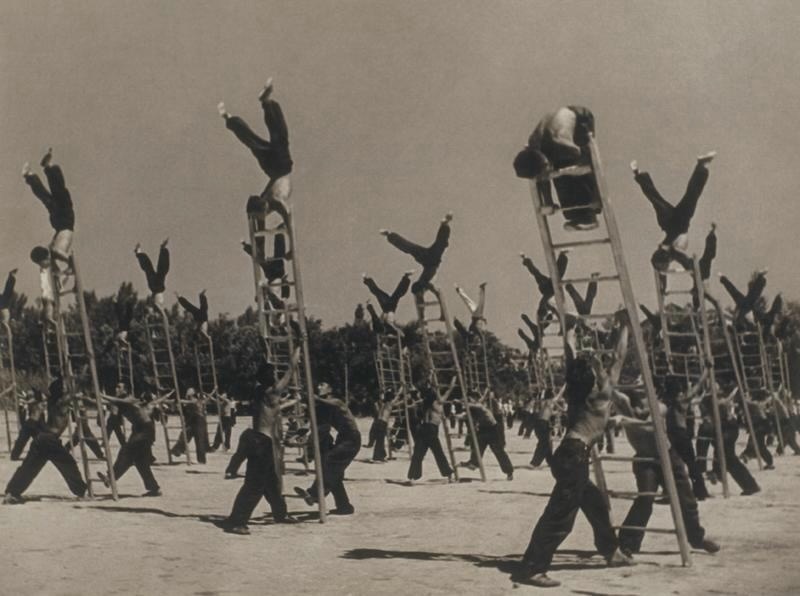
With PhotoLondon opening this week, I found myself remembering that great photography was shown at Somerset House before PhotoLondon was ever a thing. There used to be housed in the Embankment Galleries at the lower level the great hoard of the Gilbert Collection, since then moved to the Victoria & Albert Museum. The Gilbert Collection, for reasons which were not very clear, hosted a succession of very good exhibitions of photography of Soviet origin, curated by Olga Sviblova of the Moscow House of Photography (as was) and paid for – and this might indeed explain why they happened at all – by Roman Abramovich. One of them was devoted to Max Penson, and this picture is his.
Penson was born in 1893 in Velizh, about half-way between Moscow and Riga. He went to art school in Vilnius in Lithuania before he was forced east by the anti-Jewish pogroms of the first world war. He settled in Uzbekistan and worked from 1926 until 1949 as an official photographer for Pravda Vostoka, the “Truth of the East”. His pictures were circulated by TASS, and he had more than one spread in the famous Soviet magazine “USSR under Construction”, a journal whose uninspiring title conceals a goldmine for anybody interested in the history of Russian photography. So Penson found himself in the privileged (and dangerous) position of being paid to chronicle the upheaval as Uzbekistan was dragged kicking and screaming into the Soviet century. The clash of cultures between the traditional Uzbek and the Soviet is the subject of Penson’s work.
Penson’s manner was modest, but we learnt that he had a quiet streak of non-conformism that was amazing when what you were supposed to conform to was laid down by Stalin, with the very present risk of not complying. In the catalogue essay of that exhibition from 2006, Olga Sviblova drew attention to the way some of Penson’s retouching work seems so exaggerated as to be ironic, and the same impression comes from much of the photography itself. We see a photographer who knew how to make the images that his masters required, but who seemed to build into them a degree of whimsical irony. Is it only hindsight that imbues these pictures with the seeds of their own parody? Penson’s compositions are strikingly graphic, sometimes in a kind of dutiful but rough homage to Soviet social realist tendencies (although he never seemed quite to commit himself to those in full).
This picture of collective gymnastics does not show the kind of perfect harmony that was expected from such displays. Instead, the acrobat nearest to us has very visibly lost his balance and his supporting partners are within an ace of dropping the ladder. It might have spoilt the display a bit, if you were minded for military precision. The minute you notice it, you can’t help but see that all the others are more or less teetering, too. Ladders are definitely not parallel. One or two athletes didn’t get the order to wear the dark trousers. Suddenly, the whole scene is punctured a bit. That little wobble, and Penson’s courage in preserving it, makes all the difference to the picture. It’s the wobble that survives.
 Francis Hodgson
My mind works in funny ways. What came to mind when I saw this image was Tatlin’s Tower.
LikeLike